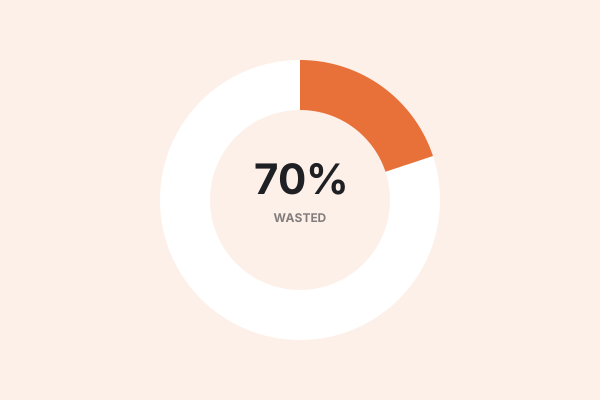
Here is a number that should alarm every sales leader: the average SDR spends just 28% of their working day on activities that directly generate pipeline. The rest is consumed by account research, list building, CRM administration, internal meetings, and context-switching between tools. According to Gartner's sales productivity research, this ratio has barely improved in a decade despite billions invested in sales technology.
You are paying your SDRs to sell. They are spending most of their time doing everything except selling. The problem is not your people. The problem is your process.
The Typical SDR Day: A Breakdown
That 35% on account research is the killer. Your SDRs arrive each morning, open LinkedIn, open a company website, open a job board, open Crunchbase, and start cobbling together a picture of whether a company is worth contacting. They do this for 15-25 accounts per day, and the vast majority of those accounts will never reply.
The Bridge Group's SDR Metrics Report confirms this pattern: the median SDR produces 8-12 qualified opportunities per month. When you consider that most SDR teams are targeting 100+ accounts per week, this represents an enormous amount of wasted research effort.
The Research Trap
The research trap works like this:
- Marketing or ops delivers a target account list of 5,000-20,000 companies based on ICP fit.
- The SDR has no way of knowing which of these companies are in-market right now.
- So the SDR researches each account manually, trying to find a reason to reach out.
- Most accounts show no obvious trigger, so the SDR writes generic outreach.
- Generic outreach gets a 1-2% reply rate.
- Leadership sees low reply rates and tells the SDR to "personalise more."
- The SDR spends even more time researching each account.
- Throughput drops. Pipeline drops. Everyone is frustrated.
The trap is that "do more research" feels like the right answer, but it's actually making the problem worse. The issue is not insufficient research per account. The issue is insufficient signal about which accounts to research in the first place.
You don't have a personalisation problem. You have a prioritisation problem.
Signal-First Prospecting: The Math
Let's compare the two approaches with real numbers.
Traditional Approach (ICP-Only)
- SDR researches 20 accounts per day (35% of time = ~2.8 hours)
- Sends 50-60 emails per day
- Reply rate: 2%
- Replies per day: ~1
- Meeting conversion: 40% of replies
- Meetings per week: ~2
Signal-First Approach
- SDR receives 25-40 pre-qualified, signal-enriched accounts per week
- Research time drops to 30-45 minutes per day (signals provide the context)
- Sends 35-45 highly targeted emails per day
- Reply rate: 12%
- Replies per day: ~4-5
- Meeting conversion: 50% of replies (higher quality conversations)
- Meetings per week: ~10-12
The signal-first SDR sends fewer emails but books 5x more meetings. Their throughput on the activity that matters, qualified conversations, is dramatically higher. And they get to leave work on time because they are not drowning in manual research.
Implementation Guide: 4 Steps to Signal-First SDR Operations
Step 1: Audit Your Signal Sources
Map out every source of buying signals you currently have access to. This includes your CRM data, LinkedIn Sales Navigator alerts, job board monitoring, news feeds, and any intent data providers. Most teams find they have fragments of signal data scattered across 5-10 tools with no unifying layer.
Step 2: Define Your Signal Hierarchy
Not all signals warrant the same response. Build a tiered system:
- Tier 1 (immediate outreach): Leadership change in buying department + hiring signals. These accounts get personalised, multi-channel sequences within 48 hours.
- Tier 2 (priority outreach): Funding events, expansion signals, technology changes. These get personalised email sequences within the week.
- Tier 3 (nurture): Engagement signals, strategic announcements. These enter automated nurture sequences with periodic manual check-ins.
Step 3: Restructure the SDR Day
With signals pre-delivered, the SDR day transforms:
- First 30 minutes: Review new signals, prioritise Tier 1 accounts.
- Next 3 hours: Execute personalised outreach on Tier 1 and Tier 2 accounts.
- Next 2 hours: Follow-ups, calls, LinkedIn engagement.
- Final hour: CRM updates, prep for tomorrow.
Notice what is missing: the 2-3 hours of manual research. That time is now spent on outreach and conversation.
Step 4: Change What You Measure
Traditional SDR metrics (emails sent, calls made) incentivize volume over quality. Signal-first metrics prioritise outcomes:
- Reply rate (target: 10%+)
- Signal-to-meeting conversion (target: 15-20%)
- Time-to-first-touch after signal detection (target: under 48 hours)
- Meetings booked per signal batch
The Management Shift
This is not just a process change. It is a management philosophy change. As Gartner's sales enablement research shows, the highest-performing sales organisations are moving from activity-based management ("make more calls") to insight-based management ("work the best accounts").
Your SDRs don't need to work harder. They need better information about where to focus their effort. When you solve the information problem, the productivity problem solves itself.
At HighTempo, we provide the signal infrastructure that makes this transformation possible. We monitor your ICP for buying signals, triangulate them into high-confidence leads, and deliver them to your team weekly with full context for personalised outreach. Your SDRs stop researching and start selling.
Book a call to see how signal-first prospecting could transform your SDR team's output.