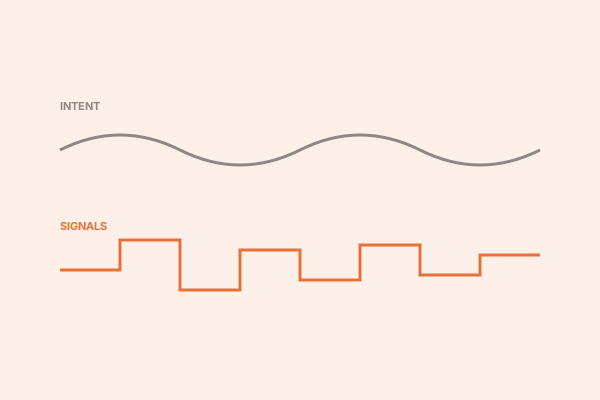
If you work in B2B sales or marketing, you have almost certainly heard the terms "intent data" and "buying signals" used interchangeably. They are not the same thing. Understanding the difference, and knowing when to use each, is the key to building a prospecting engine that actually works.
Let's break down how each works, where they shine, where they fail, and why the combination of both through triangulation produces results that neither can achieve alone.
How Intent Data Works
Intent data providers like Bombora and 6sense track online research behaviour to infer purchase intent. The mechanics vary, but the core approach involves:
- Tracking pixels and cookies: Placed across a network of B2B publisher sites (review sites, industry publications, analyst websites). When someone from a company visits pages about "CRM software" more frequently than their baseline, that company gets flagged as showing intent for CRM solutions.
- IP-to-company matching: The provider maps the visitor's IP address to their employer, usually through a combination of reverse IP lookup databases and probabilistic matching.
- Topic modeling: Content consumed is categorized into topics. When a company's consumption of a topic surges above its historical average, an intent "spike" is registered.
The output is typically a weekly or monthly list of companies showing "high intent" for specific topics, scored on a scale. Forrester's research on intent data has documented that these platforms work best when monitoring broad category-level interest across large account universes.
How Buying Signals Work
Buying signals are observable business events that indicate a company may be entering a buying cycle. Unlike intent data, which infers intent from anonymous browsing behaviour, buying signals are concrete, verifiable events:
- A new VP of Sales is hired (LinkedIn, press releases)
- The company posts 5 SDR job openings (job boards)
- Series B funding is announced (Crunchbase, news)
- A competitor's technology is adopted or removed (technographic monitoring)
- A new office opens in a target geography (company news, filings)
The critical difference: you can point to a buying signal and say "this happened on this date." You can verify it independently. You can reference it in outreach. Intent data, by contrast, tells you "someone at this company has been reading about this topic," but you typically cannot tell who, what specifically they read, or whether the research is related to an actual purchase.
Intent data tells you someone is researching. Buying signals tell you something has changed. The most powerful prospecting combines both.
Mapping to BANT: Where Each Type of Data Shines
The classic BANT framework (Budget, Authority, Need, Timeline) is useful for understanding where each data type provides signal:
| BANT Element | Intent Data | Buying Signals |
|---|---|---|
| Budget | Weak. Cannot determine budget allocation. | Strong. Funding events, budget announcements, expansion spending directly indicate available budget. |
| Authority | Weak. Usually cannot identify the individual researching. | Strong. Leadership hires identify exactly who has decision-making authority. |
| Need | Moderate. Topic-level research suggests interest in a category. | Strong. Hiring patterns, tech changes, and strategic announcements reveal specific operational needs. |
| Timeline | Moderate. Intent spikes suggest active research phase. | Strong. New leader "90-day window," post-funding deployment pressure, and job posting urgency all imply specific timelines. |
As you can see, buying signals provide stronger evidence across all four BANT dimensions. Intent data's advantage is scale: it can monitor thousands of companies simultaneously at a category level, which buying signals cannot always match for breadth.
The Quality Problem with Intent Data
Intent data has real limitations that are worth understanding before you invest heavily:
1. IP Matching Accuracy
With the rise of remote work, VPNs, and cloud-based browsing, IP-to-company matching has become increasingly unreliable. A single IP address might be shared by dozens of companies in a co-working space. A company's employees working from home may not register on the corporate IP at all. The result is both false positives (intent attributed to the wrong company) and false negatives (real research not detected).
2. Cookie Deprecation
As third-party cookies are phased out across browsers, the tracking infrastructure that powers many intent data providers is eroding. While providers are developing alternative approaches, the accuracy and coverage of cookie-based intent data will continue to decline.
3. Topic Granularity
Intent data tells you a company is researching "sales engagement" but cannot distinguish whether they are evaluating new tools, writing a blog post about the space, or doing competitive analysis. The topic-level signal is useful but ambiguous. As Bombora's own best practices guide acknowledges, intent data works best as one input among many, not as a standalone prioritisation mechanism.
4. Latency
Most intent data is delivered weekly or monthly, with processing delays that mean the underlying research behaviour may have occurred days or weeks earlier. By the time your SDR acts on the intent signal, the company may have already advanced in their buying journey.
The Triangulation Effect
The real power emerges when you combine intent data with buying signals. This is the triangulation approach that produces the highest-confidence leads.
Consider three scenarios:
- Intent data alone: "Acme Corp is showing high intent for sales engagement." Your SDR knows Acme is researching, but not why, not who, and not what to say. Reply rate: 3-5%.
- Buying signal alone: "Acme Corp just hired a new VP of Sales." Your SDR has a concrete event to reference, but doesn't know if Acme is actively evaluating solutions. Reply rate: 8-12%.
- Intent + Signal triangulated: "Acme Corp hired a new VP of Sales, posted 4 SDR roles, AND is showing high intent for sales engagement." Now your SDR knows who (the new VP), why (scaling the team), and when (they're actively researching right now). Reply rate: 15-25%.
Triangulation doesn't just add the two data types together. It multiplies their value, because each type compensates for the other's weaknesses. Intent data adds the real-time research dimension that buying signals lack. Buying signals add the specificity, verifiability, and BANT coverage that intent data lacks.
Making the Right Investment
If you are deciding between intent data and buying signal monitoring, here is our recommendation:
- If you sell to enterprise accounts (1,000+ employees): Start with buying signals. Enterprise companies generate many observable events, and the deal sizes justify personalised outreach. Layer in intent data as a supplementary signal.
- If you sell to mid-market (100-1,000 employees): Buy both, but lead with buying signals for prioritisation and use intent data for timing. This is the sweet spot for triangulation.
- If you sell to SMB (under 100 employees): Intent data is less reliable for smaller companies due to IP matching challenges. Focus on buying signals, particularly hiring patterns and funding events.
At HighTempo, we build custom signal-monitoring systems that incorporate multiple data types, including buying signals, technographic changes, and where relevant, intent data, to deliver triangulated leads with the highest possible confidence levels. We define the signal architecture that matches your specific product and market, so every lead comes with context your team can act on immediately.
Want to see what triangulated intelligence looks like for your ICP? Book a call and we'll walk you through it.